










How RTB Ad Serving Works

Published on: 04 September 2019 Last Updated on: 13 September 2024
RTB

Programmatic RTB has become one of the leading technologies for ad serving for the last few years. To say it simply, RTB ad network reminds an auction, however, we are going to look at this process of ad serving in details for you to understand it better.

As you could guess, Real-Time Bidding operates with the data here and now. In short, when a user comes to a website joined to a programmatic ecosystem something like the following happens: cookies read user’s characteristics (location, approximate age, interests, type of the device and browser), after which advertisers are bidding how much they are ready to invest in this particular impression, a winner with the biggest bid shows his ad. The process takes time while the page is loaded, everything is finished when the ad was displayed. It all begins again with a new visitor.

Key benefits of RTB advertising

First of all, the issue of transparency becomes one of the most important. Traditional ad networks are not so good at it, as fraud problem is quite common for them. While here each display can be checked and examined.

Besides, an important financial point arises. Local companies even with small budgets can participate in promoting their goods and services, the same as websites where the audience is something like 1 000 visitors or a bit less.

What does RTB Advertising Comprise of?

There are several participants performing their strict roles to organize clear and high-speed process.

  1. SSP (Sell Side Platform) – a platform of automatic traffic sales for websites owners (publishers) with auction estimation of its cost. SSP acts for playgrounds and responsible for sales at the biggest price and auction winner defining.
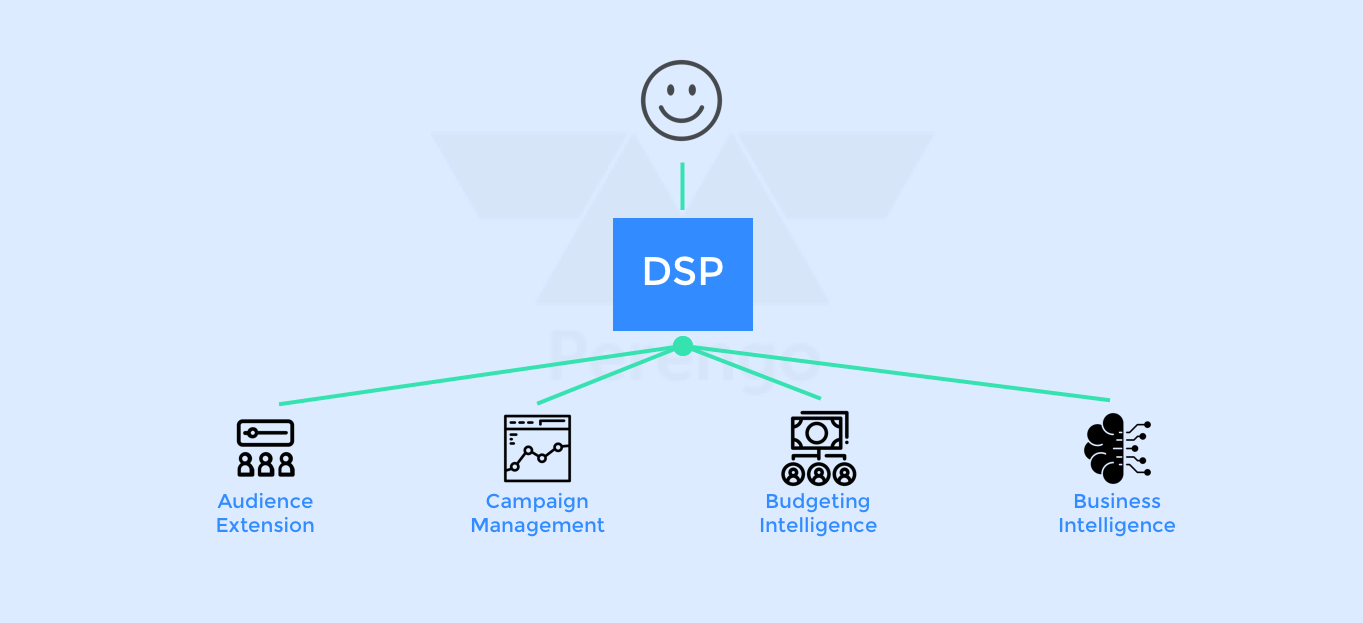
  2. DSP (Demand Side Platform) – it is a place where advertisers (private individuals, agencies, companies) obtain displays from various advertising exchanges. Here advertiser’s interest is taken care, like buying impression at the lowest coast, obtaining real-time statistics about displays.
  3. Trading Desk – it can be compared with a dashboard. It is a place where RTB starts for an advertiser: he sets necessary parameters about desirable audience and budget limits.
  4. Online advertising network – it works like a third-party between publishers and advertisers. It unites platforms according to owners’ requirements and offers the best variants to meet advertisers’ demands.
  5. Ad Server – it is a technically complicated block that delivers special software for both parties involved in the process so that they can to run ad allocation and its optimization. It represents banners database and its features for ad networks.
  6. DMP (Data Management Platform) – this service was created to handle for audience targeting: analysis, segmentation, users’ anonymous profiles organization and using the information obtained for showing the ad required at this particular moment.
  7. Data Broker (Data Suppliers) – this service collects and sales to DMP platforms anonymous users profiles, including their consuming behavior, interests and other factors that help targeting to be more precise. The system uses cookies data, pixel tag, mobile and social media platforms identifiers, etc.
  8. Ad Exchange – it is necessary to establish a connection between advertisers and websites, traffic bidding is organized there.
  9. Ad Verification & Brand Safety – this block was created to deal with security issues, we need it for post-checking the ads, protect brands from banners that were created and posted in wrong manner, cleanliness of traffic, undesirable surrounding and so on.

Why RTB Advertising is Popular?

Programmatic is quite popular and it is often referred to as RTB. However, it is not the only variant of performance.

Displays can be obtained for a period of time or as an amount. In this case Advertiser and Publisher communicate directly about pricing and other terms. Programmatic is used there as an ecosystem for effecting a transaction.

Read Also:
Content Rally wrapped around an online publication where you can publish your own intellectuals. It is a publishing platform designed to make great stories by content creators. This is your era, your place to be online. So come forward share your views, thoughts and ideas via Content Rally.

View all posts

Leave a Reply

Your email address will not be published. Required fields are marked *

Related

Advertising

New Platforms to Explore in Advertising this Year

Each year is treated by marketers as a time to shed old methods and adopt new ones. This past year saw major upheavals in online search algorithms and privacy standards (to name a few). For average customers, this means less of the same annoying “tricks” used for summoning consumer’s cash. Marketing developers will need to come up with new strategies based on winning the buyer’s trust. As e-commerce grows at an annual rate of 23%, the cost of digital advertisements will increase. These costs can be cut once marketers begin adopting revolutionary methods of ad placement. Listed below are just a few of the new platforms to explore in online advertising for 2019. New Platforms to Explore in Advertising this Year: Demand Side Platforms: Purchasing ads couldn’t get easier with Demand Side Platforms. DSPs use supply-side platforms to streamline bidding and posting. The ad’s impression information is sent to the SSP for processing where it’s then matched to the highest bid within their algorithm. Ad purchases take a few seconds; the same amount of time it takes to load a webpage. The program uses data such as demographics and visits counts for audience targeting. This ensures an ad will get only the highest exposure. Dashboards: Anyone with a YouTube page will notice the dashboard feature located in the “Creator Studio” section. This dashboard provides charts for the amount of time spent watching a video, the number of subscribers, and how many “Likes” and “Dislikes” it received. App developers have now been able to make this platform and make it a bit more streamlined. Companies, like Sprout Social, are creating customizable dashboards attuned to a business’s specific analytics. All current data can be collected and calculated to generate presentation-ready graphics. Certain features even allow you to synch these dashboards with multiple social media accounts. Wearables: In an age where refrigerators can be smart, even the accessories we wear can have internet capabilities. Wearable devices like smart watches make accessing data less complicated as we move about our daily activities. Marketing agencies are abuzz with various methods to introduce wearable device and programs. Wearable ads go hand in hand with blockchain technology. A block chain model can be used to authenticate user IDs and provide tokens to register them. Through the IDs, businesses will be able to track the user’s buying habits so online ads can be precisely placed and scheduled. These new features may even be used to gauge the customer’s personality traits. Transparency: News of hackers and trolls are causing consumers to hold off on accepting any offer from an online business. The more profitable a business is, the more it is held to the same light as government and relationships. That’s why it’s important to seek out transparent platforms for use. Transparency is a virtue that many potential customers are willing to spend the extra dollar on. Areas that customers demand transparency on include company values, practices, and policy or pricing changes. Honesty, when answering questions and admitting mistakes, is the best demonstration of transparency. Read Also: Who Are The Best Software Vendors Out There? 3 Things To Consider When Designing A Company Logo For Your Business

READ MOREDetails
Manage Your PPC Budget

Seven Smart Ways To Manage Your PPC Budget

PPC is a cost-effective technique to help the business grow its brands and achieve higher profits as well as gain customer trust. When initiating a PPC campaign, the first thing is to look at your budget. The budget is the amount of money you would wish to spend on online advertising, whether to increase sales, boost brand awareness for acquisition efforts, or email sign-ups. There are several factors that are dependent on creating the budget: Lead quality. Visits frequency. Conversion rate. Cost-per-clicks (CPC) Your location. However, the success of paid advertising intuition depends on how well you plan. The effective implementation of an action plan in the budgeting process can assist you in uncovering the full potential of the business’s digital effort. Thus, in this article, you will discover methods to create a budget for your PPC ads smartly. Why Is Budgeting So Important In PPC? Whether you are a small business or a large part of the multi-national, it is integral that you set a budget for every PPC campaign that you run. This is because, without any clear budget, you would be spending far more than you should and will not be able to maintain any calculation for your cost-per-conversion. If you can face revenue loss and a significant dent in your finances, you can get assistance from PPC management services. If there is any budget mismanagement, it would cause your business to face serious financial ramifications outside the advertising. So, maintain a lid on your business spending and know where the money goes. Smart Ways To Manage PPC Budget Despite the PPC campaign being a great way of obtaining long-term growth and revenue, it is only successful if the ROI and budgeting are managed efficiently. Here is a list of seven smart ways to manage your PPC budget. 1. Ensure Using Historical Data  The use of a spending projection tool offers valuable insight into projected spending. When you analyze historical and recent trends and performance, you can automatically calculate the projected spending range. In this way, you can monitor the spending all throughout the week and proactively identify the potential overspending, thereby ensuring that you stay within the desired budget limitations. 2. Allocate Budget To Enhance Performance  You can find an optimization tool if you plan to optimize your budget. One is to optimize budgets, and the second is to optimize budgets across the platform. However, it is vital to note that Google ads and other ad platforms usually operate with budgets for campaigns and set levels, along with the shared budgets encompassing multiple ads. However, the use of optimization tools will assist in bridging the gap between the targets set month-wise and are commonly used by companies and the daily budgets required by the ad platforms. 3. Identify Best Keyword For Your Marketing Objectives Before you can identify the PPC budget, specifically for the search campaign, you need to place the search terms that the potential customers use when searching for products. However, this approach can be straightforward for businesses such as e-commerce stores; it can also get tricky if the product is a solution to a niche issue. Moreover, you can determine how to track the marketing dollar's effectiveness best. In addition to that, you can also focus on significant terms that have immediate purchase intent. When there is a high-intent keyword, it is likely to have an enhanced click-through rate and concession rate. 4. Prevent Overspending Through Automated Budget Control  In order to automate your budget management, be flexible with the advertisement on Google. With the help of the application, you can check the updates every single hour. Thus, by setting up the script, you can automatically process the pause campaign keywords and label them when the cost exceeds the maximum. 5. Avoid Underspending  The use of Budget Management Enhanced Script, you can effortlessly stay on track with the client’s budget target and make sure there is optimal spending without any trouble of constant panning and manual adjustments. When you combine the scripts, you can stop budgets from overspending and gain better control over monthly spending. 6. Estimate Your Profit  You can use return on ad spend (ROAS) as an alternative to estimate digital advertising performance and record most marketers' tactics. You should estimate how to measure target ROAS. It is the ratio between the amount spent on an ad campaign and the total revenue that is bright with it. The decision of an ad campaign will generate revenue; you are required to estimate the customer’s LTV against the cost of customer acquisition for each ad campaign. 7. Run Your Planner Report  You can use Google Keyword Planner, a powerful tool that allows you to refine the audience and budget. It also offers several options that allow you to look for new keywords and combine a list, forecast cost performance, get clicks, and show search volume trends and data. Summing Up Thus, it is clear that every business’s first approach should be to manage costs and be mindful of how and where they spend. Depending on several factors, which include the business goals, your preference, and ad spending. Therefore, when it is catered effectively, it can result in an efficient PPC campaign that brings in favorable sales units. Remember that pulling meaningful data can support your decision when working through these steps, either the historical PPC campaign or the insight gained from Google Analytics. Just ensure that you will use the right budgeting methods from the beginning to complete the work correctly. Read Also : Top 4 Reasons To Outsource White Label PPC For Your Business Organic Traffic Vs. Paid: Where Should You Focus Your Budget?

READ MOREDetails
Your ad can show to a potential customer when your targeted language matches:

Your Ad Can Show To A Potential Customer When Your Targeted Language Matches

Question: Your ad can show to a potential customer when your targeted language matches: The customer’s browser setting The customer’s Google interface language setting ✓ The customer’s operating system language The language of websites a user visits most often Answer: The customer’s Google interface language setting Explanation: Your ad can show to a potential customer when your targeted language matches the customer’s Google interface language setting. Keep in mind, language is targeted on the basis of potential customer’s Google interface language setting. Now, let’s discuss this in detail.  Reference: https://school4seo.com/adwords-fundamental/your-ad-can-show-to-a-potential-customers-when-your-targeted-language-matches/ How To Change The Interface Language In Google Chrome? Google Chrome decides your most preferred language on the basis of your computer’s default language settings. However, if you change your default language, you need to change all your settings again and the elements would appear in a new language. Changing the interface languages of the Google Product has two solutions clearly and these are: changing a URL parameter and changing the language of your account. Now, let’s discuss the top steps for changing the interface language in Google Chrome. Open Chrome Settings Under Advanced, Click on Languages  Tap on the drop-down menu  Tap on Add languages You can choose languages from the list and click on Add Your preferred language will be added to the list.  Click on the three-dot icon in front of the language.  Check the box for the offer to translate pages in this language. Click on Relaunch So, these are the top steps that you need to follow to change the interface language in Google Chrome.  The Final Thoughts  The customer’s Google interface language setting is the answer to your question “Your ad can show to a potential customer when your targeted language matches.” Changing the language used in Chrome takes only a few steps and you need to follow the same to meet your objectives. More Resources: How Customer Success Can Help Grow Your Business 5 Ways To Fix Chromecast Source Not Supported Error How To Use Chromecast From Firefox - Step By Step Guide In 2021

READ MOREDetails