










Financial Plan For Your FIRST Small Business – Low Budget Plan

by

12 September 2024

Finance

Financial Plan For Startup Business

One of the common reasons why small businesses fail is the lack of working capital. Poor financial decision-making can be detrimental to your small business.  

This will not scare you or put you off the idea of starting your very first business. However, it is to convince you how important it is to draft a financial plan for your small business.

The importance of predicting your financial health is not just to maintain a steady cash flow but also…

Understand how lucrative your business is in the long run.

How long will your business be at break-even (no profit, no loss)?  

When can your business start making a profit?

Most importantly, what is the contingency plan of any financial hurdle?

In this blog post below, we will be discussing the following:

  • Importance of a financial plan for your small business.
  • Elements of a financial plan for your small business.
  • A template to create a small business plan (for any business).

Importance Of A Financial Plan
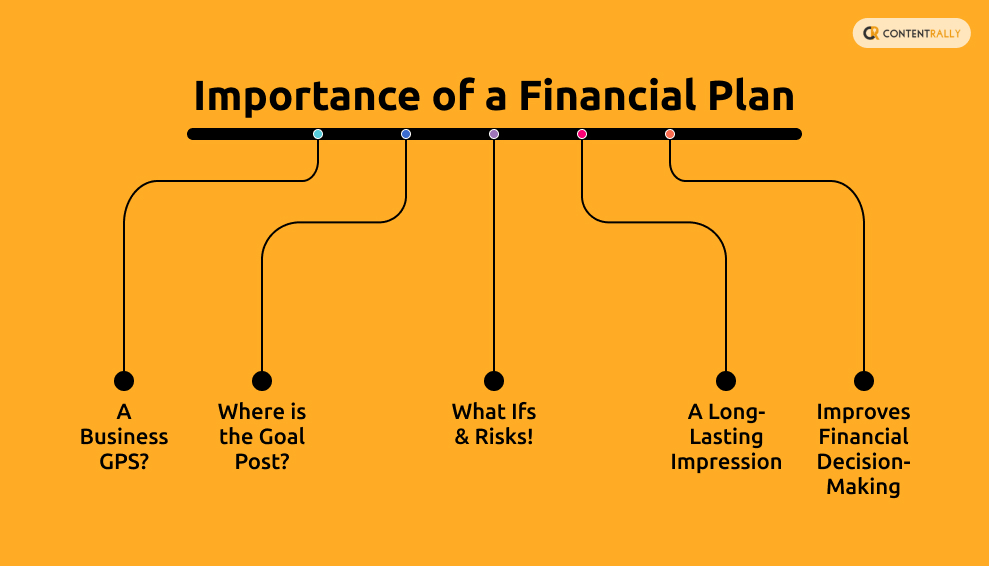
Importance Of A Financial Plan

Here is why you should begin creating your very first-ever financial plan for your small business.

1. A Business GPS?

Imagine yourself driving to a new destination without knowing where you are or in which direction you should proceed.

This is what it is like to open a business without having a financial plan.

A financial plan will give you a clear roadmap to your business journey, and determine how much to spend on each destination.

2. Where Is The Goal Post?

We all have a vague idea of what a startup goal should be. However, getting overwhelmed is common without a clear picture.

A financial plan will provide you with a clear goalpost. I am talking about tangible, measurable, and achievable goals.  

Whether you want to expand your business, increase profits, or reduce costs, a financial plan gives you a clear path.

3. What Ifs & Risks!

It is given that your business won’t be smooth sailing forever!

Businesses often face unexpected expenses. It could be something as simple as equipment breakdowns or sudden major market changes!

As a business owner, being financially ready is a crucial step!

A financial plan can help you set aside emergency funds, so you’re prepared for these surprises.

4. A Long-Lasting Impression

Want investors early on for your business? Then, it would help if you offered them a steady financial plan.

Remember, lenders and investors want to see a well-thought-out financial plan before they commit their money.  

Therefore, having a solid plan shows them that you understand your business’s financial health, its cash flow, and the potential profit opportunity. Hence, we are serious about making your business a success.

5. Improves Financial Decision-Making

With a financial plan, you better understand your cash flow, revenue, and expenses.  

This knowledge helps you make informed decisions, like when to invest in new equipment or whether to cut costs.

Important Elements Of The Financial Plan Of A Small Business
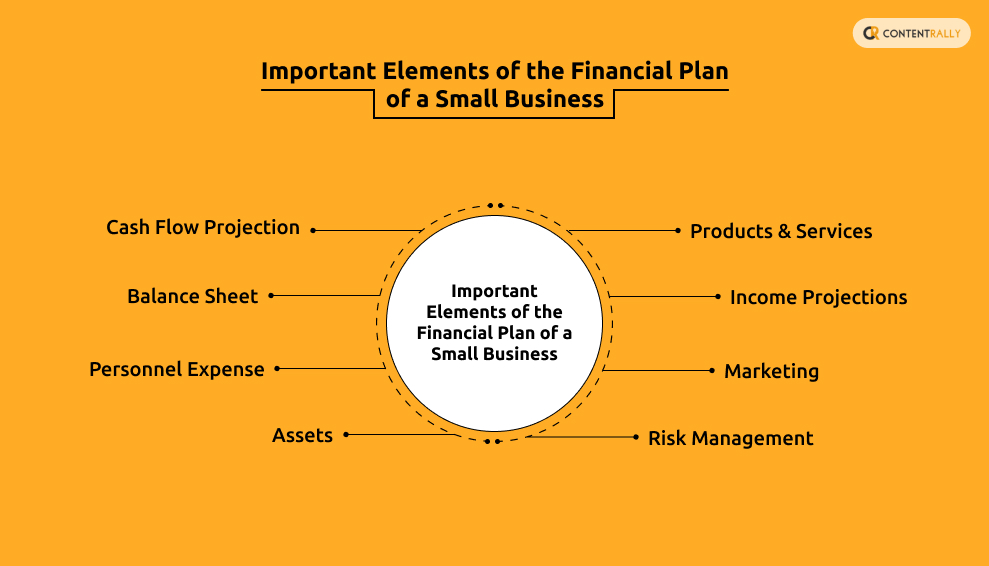
Important Elements Of The Financial Plan Of A Small Business

Before you begin your financial planning, you should be aware of the different financial jargon for a business.

1. Cash Flow Projection

This includes predicting the market, what effect your product will have on the market, and how much you can earn from it.

Now, taking the potential amount you create capital expenditure for each month. The function of a cash flow projection is to ensure you have enough (at the end of the month) in terms of expansion.

It is common for a business to live month by month with no profit for the first six to eight months of the business. Essentially you are establishing your business.  

However, if it crosses the one-year mark with just a break-evens, the following could be the reason:

  • Your business is not making money because of the lack of demand.
  • The expenditure is way over your income. You must start some cost-cutting methods.
  • There is a lack of marketing, and your small business is not reaching the target audience.
  • You do not have enough investment for the small business you are starting.

Keep these points in mind when starting your cash flow!

2. Balance Sheet

A balance sheet is a financial estimation of your small business’s current state. Here are some of the important items your balance sheet will have:

  • Income & Expenditure
  • Total owning & total owing (personal debts or small business loans).
  • Assets that are currently under collateral.

Upon reading it might sound simple. However, when it comes to a balanced business sheet, you will require a finance professional to craft one.

3. Personnel Expense

This brings us to the next point in any financial plan for a small business. The personnel expense, or the amount you are spending on hired personnel.

It doesn’t always have to be your employees. In fact, the number of employees for a small business will hardly reach 15 in the very first year.

A personnel expense includes individuals working as consultants for the business, and the different professionals you hire to help with the internal work (e.g. Finance officer to create the balance sheet).

Some of the common elements of a personnel expense are:

  • Cost is based on the positions each professional is holding.
  • Personal insurance plans for your workers (at least medical insurance).
  • Expenses are spared for other professionals working externally with the business.

4. Assets

The tangible assets that your small business owns:

Current Assets: What the business currently owns. These include inventories, machinery & tech devices, prepaid expenses (for example, digital tools), and other office supplies.

Tangible Assets: The one that physically exists under the name of your small business. Real estate (This will not include rented warehouses or offices. These will go under the expenditure section), land inventory, tangible investment (gold & bonds), and saleable merchandise.

Non-Tangible Assets: These are assets that are not in a physical form. Intellectual property, pre-paid tools, investments (stocks, Cryptocurrency, mutual funds).

Non-Operable Asset: Assets under your small business but from which you are not getting any income. For example, land you have an investment in but not yet open for any business-related functions.

Operable Asset: Assets that your business owns currently, and that are bringing some income. For example: produced goods, factory space, warehouses, and office space.

5. Products & Services

The products and services you are planning to offer will also come into the financial planning for small businesses.

These include the following:

The raw materials are required to create the goods.

  • Factory costing.
  • Warehouse costing.
  • Transport & Drop shipping costing.
  • Worker’s salary & insurance.
  • Contingency management funding. (In case of any accident or unpredictable situation).

The summation will give you the total cost of production. With which you can create and understand the market value of your product.  

This step is very important to assess the profit and loss of each item.

6. Income Projections

Another crucial part of small business finance planning is prediction. This is how you can predict whether your income will have any substantial income.

Here is how you can protect your business income (before starting it):

  • Check business income projections of competitors through several data analyses. 
  • Is your small business subject matter trending in the market? What is the current market share of such companies?
  • Are investors willing to invest in a business venture as such? In fact, check some of the Shark Tank successes, and analyze which business venture seems more profiting by investors themselves.
  • The inflation rate of the past decade regarding the product or service you are about to sell also matters.

7. Marketing

You cannot spend everything on logistics and not worry about marketing.  

One cannot ignore this matter, especially in today’s day and age when small businesses are reaching new milestones by a simple influencer shoutout, or social media virality!

Here are some of the factors in which you will need to spend in marketing:

  • Social media marketing tools.
  • Influencer marketing.
  • Small ad-films over YouTube.
  • Website building and digital marketing (Website domain and SEO tools).

8. Risk Management

No business is protected from the risks that come to every business in its lifespan. However, the contingency plan is not getting ambushed by a sudden change.

Here are some of the financial risks/uncertainties your new business could face:

Market Risk: The ups and downs of the current & dynamic economy. In fact, after the pandemic, things have become a little less predictable.

Reputation Risk: Social media is indeed bringing customers and businesses closer. However, the downside of such connectivity is the risk of a tampered reputation, especially when audiences jump to conclusions upon hearing anything on the internet.

Competition Risk: This is a common risk every business faces. When your competitors launch something new & exciting, there could be a significant shift in sales numbers for you.

Environmental Risk: One good example of environmental risk that has previously impacted businesses majorly is the pandemic.

Political Risks: The political scenario of your country can have a considerable effect on your business, especially in terms of export-import & business expansion.

This is one of the reasons why having a financial contingency plan for managing sudden risk is one of the crucial components of a business financial plan.

Business Template For A Startup

Business Template For A Startup

As promised, we have a business template that will help you take that very first step for your startup.

Financial Plan For Startup (Template)

Table of Contents 

1. Financial Overview: A Financial Overview will consist of a financial overview of your business’s current state. Also, please provide the key points and takeaways of the financial data that you will provide.

4. Assumptions – Market Research: This is the step for market research and predicting the business’s profit potential.

5. Break-Even Analysis: A table or graph which provides information on the number of units your business needs, and how much you need to sell to make a profit.

6. Financial Statements: This will include the following charts.

– Profit & Loss (Optional if you have a startup)

– Cash Flow Statement (How the monthly cash flow will look)

– Balance Sheet (Monthly/Quarterly/Yearly Income & Expenditure)

Elements For Your Balance Sheet

The following is what your balance sheets should include based on items required: monthly, quarterly, and yearly income & expenditure.

Operational Financial Plan

  • Business Location and Facilities
  • Technology and Equipment
  • Key Operational Processes
  • Supply Chain and Inventory Management

Management and Organization Financial Plan

  • Organizational Structure
  • Key Management Team
  • Roles and Responsibilities
  • Hiring and Training Plan

Financial Plan

  • Start-up Costs (for new businesses like loans, downpayment; collateral, and personal investments)
  • Revenue Projections
  • Expense Projections
  • Cash Flow Statement
  • Profit and Loss Statement
  • Break-even Analysis

Funding Requirements and Strategy

  • Funding Needed
  • Purpose of Funds
  • Potential Funding Sources
  • Funding Timeline

Key Risks

  • Risk Mitigation Strategies

Financial Tools to Ease Your Job

In the modern age of technology, you can always lean on tools to automate some of the financial tasks.

So, if you need that digital assistance when

Begin Your Journey!

This is a sign for you to begin your journey as a first-time business owner. Yes, it is overwhelming, and yes it can be intimidating (hence the long procrastinating period!).

Creating a financial plan for even a startup can be intimidating. Here is how you can make this journey a little easier.

Start with defining your business first. The executive plan is a must. You should know what your business is all about.

Then, move through the basic income and expenditures.

Take help from professionals in tax advice and create a detailed balance sheet.

Finally, consider seeing your whole financial plan in a timely manner. It is important to take one step at a time.

Hopefully, we can give you enough answers about a business financial plan. How is your journey going? Please let us know in the comment section below.

Read Also:

Content Rally wrapped around an online publication where you can publish your own intellectuals. It is a publishing platform designed to make great stories by content creators. This is your era, your place to be online. So come forward share your views, thoughts and ideas via Content Rally.

View all posts

Leave a Reply

Your email address will not be published. Required fields are marked *

Related

Savings Goals

Make Your Savings Goals Come True with Gold

What are your investment goals? Some of the most common savings and investment goals people have are retirement, education funds for children, saving to buy a home, starting a business, switching to a more satisfying but lower paying career, getting married, or even going on a vacation. These are all great reasons to save and invest, and they all come with different investment strategies, timelines, and risk tolerance. None of them are mutually exclusive. In fact, you should probably be balancing a few of these investment goals at the same time. Whatever your other savings goals, retirement should always be on your mind, and that means long-term growth with a balanced portfolio. While goals such as buying a house or going on vacation may have much shorter timelines, retirement offers an opportunity to grow your savings to new heights through compound interest and balancing high-growth, high-risk investments with low-risk alternatives. Invest in Low-Risk Assets like Gold: One low-risk asset you should consider buying is gold. Many investors consider it superior to other low-risk assets like treasury deposits or money market deposit accounts. There are a few qualities that make gold a better investment: Inflation-proof; since 1971, the value of a dollar has gone from 1/40 of an ounce to 1/1300 of an ounce, while the gold-housing ratio (the relative value between gold and real estate) is about the same. Highly desirable when inflation is higher than interest rates. Performs well when stocks do poorly, helping you offset losses. Highly liquid and you can sell easily even when stocks are considered toxic. Here’s how you can get started investing in gold today. Buy Gold Online: Buy gold online for a cost-efficient way to add it to your portfolio. The prices will be lower than a physical shop, and shops today are often in the business of selling more collectible coins. Get straight to the punch by buying coins and bars that were made for the modern investor – straightforward, predictable costs and no-nonsense products. Bullion vs. Paper: Gold bullion is your safest bet for investing. You have maximum control and minimum third-party risks. Paper or ETFs place your money and your trust in management and trading practices that aren’t easy to understand, such as lending and futures trading. Gold bullion is by far the more secure option. Buy Gold Bars or Coins: Now that you’ve limited your options to physical gold bullion, there is still a lot to choose from. Gold bars and coins are more cost-effective products. All forms will have premiums over spot prices. It costs mints labor and machining to create bars and coins, and companies face expenses such as shipping, storage, and insurance, which they recoup through premiums. Gold bars have less production value than coins, so they are an excellent way to save and buy at something closer to spot prices. Gold can help you meet your investment goals. Allocating a portion of your portfolio to gold means you have a highly liquid, inflation proof asset you can depend on whenever you need it, whatever the market looks like. Read Also: Investors Agree: Gold And Silver Is The Way To Go Cut Risks And Guarantee Gains: Why Real Gold Is Attractive

READ MOREDetails
Credit Card Terms

Credit Card Terms Everyone Should Know

Whether you are a new credit card holder or have been using it for a while, you must have come across some credit card jargon that is hard to decipher. For instance, if you decide to apply for a credit card online, you might need to understand the annual fee, interest rate, and other charges applicable to that card. Even though all credit cards work in the same way, they differ a lot in terms of the benefits and rewards they offer. So, to make it easier for you to understand the basic credit card terminology and choose the best one, here is a quick guide for you. Annual Fee Card companies may charge annual fees on credit cards. This might range from a few hundred to a few thousand depending on the benefits you can avail yourself of on the card. However, certain providers may waive the fee for the first year, while others, may offer credit cards that are free for a lifetime. So, depending upon the kind of benefits you seek, you may choose a lifetime free credit card or a card that has an annual fee but may waive it off on spending a certain amount. Credit Limit This is the overall spending limit or credit line provided by the card issuer. There are several criteria such as your credit score, income, repayment history, as well as the length of your relationship with the bank that determines your credit card limit. Banks may sometimes offer you higher limits if you already have high limits on your existing cards along with a strong repayment history. Additionally, when checking your credit card limit, there are further three terms that you must be aware of Total Credit Limit and Available Credit Limit. Total Credit Limit: This is the credit limit granted by the bank when the card is issued. The total limit can also be increased when you request for the same or if you accept a limit increase offered by the provider. Available Credit Limit: This is the credit limit that is available on one's credit card at any one moment. In other terms, the available credit limit is the difference between the entire credit limit and the card's current outstanding balance. Cash Limit: Card issuers also offer a certain portion of your total credit limit as cash limit. This defines the amount of cash you can withdraw using your credit card. However, cash withdrawal from credit cards should be the last resort as cash withdrawal is not eligible for the interest-free period and even a small amount can escalate to a huge debt. Billing Cycle The billing cycle refers to the period between the closing of the previous statement and the new statement date. Your credit card provider compiles your statement at the end of your billing cycle, and you have until the due date to make the payment. Due Date This is the specified monthly date by which all outstanding payments must be made. To avoid late payment penalties and high-interest charges on unpaid dues, you must make the payment on or before the due date. Total Amount Due And Minimum Amount Due At the end of each billing cycle, a new statement is generated and it shows the dues that you owe on your card. Total amount due, as the name suggests, is the total sum that you owe to the issuer, and on making full payment, no charges will be applicable. However, if you cannot afford to pay the total due, card providers give you the option to pay the minimum amount due to keep your card active and avoid late payment charges. It is usually 5% of the total due and also includes any active EMIs, additional fees, charges, etc. An important thing to note is that on making only the minimum payment, the rest of the outstanding balance starts attracting finance charges and new transactions become ineligible for the interest-free period as well. This is why you should always pay the total due and not just the minimum amount. Finance Charges And APR Interest rates on credit card balances are known as finance charges and APR is the annual percentage of interest. It is the rate of interest on all transactions from the date of the transaction until the cardholder's balance is paid back in full. Note that interest on credit cards is compounded on a daily basis. Being acquainted with these terms will ensure judicious use of the card and help you stay out of debt. Additionals: Ultimate Guide On Green Card Renewal How to Dispute an Error on Your Credit Report Revolving Debt Vs Installment Debt – Which Impacts your Credit Score

READ MOREDetails
Why Health Insurance Matters

Which Health Insurance Plan Offers The Best Coverage For A 23-Year-Old In India

The decision of selecting the right health insurance policy at 23 is a turning point. It sets one up for a lifetime of financial security and medical coverage.   The young adults are thinking in terms of affordability, comprehensive benefits, and flexibility to shift as medical requirements change.   When a plethora of products are available in the market, it is essential to stay updated with the terms of a health insurance policy to make informed decisions.  This piece considers the crucial factors, the policy options, and advice on how to choose the best options for a 23-year-old Indian.  Why Health Insurance Matters for Young Adults?  Health insurance is usually taken to be something that the family or the elderly might need, but its importance during the young age cannot be exaggerated.   Medical insurance plans offer more than just coverage for hospital bills, but they are not just that; they serve as a safety net economically in times of urgency and help infuse preventive habits towards health.  The Rising Cost Of Healthcare  Indian medical bills are rising steadily, and even a minor medical problem can lead to handsome bills.   For a younger person who has less money saved, it can be a financially crushing experience. A well-chosen health insurance policy makes a person feel less anxious by paying for unforeseen medical bills.  Early Entry Benefits  Buying health insurance at an early age has its advantages. The premiums are low, and the policyholder remains healthy and is less likely to pay additional premiums for pre-existing conditions. Waiting times for certain conditions or treatments are also evenly spread among one's 20s.  Tax Advantages  The health insurance qualifies for tax deduction under Section 80D of the Income Tax Act and therefore provides a further push to young professionals to invest in a plan for life.  Factors To Consider While Selecting A Health Insurance Policy  While buying a policy, ensure that the insurance company is stable and sound. The best health insurance providers in India are the ones with extensive networks, high claim settlement ratios, and service-oriented offerings.   They generally provide innovative policies that can fit young adult requirements, including a cashless facility, well-being programs, and e-tools for simple policy management.   Selecting a suitable health insurance policy entails a proper evaluation of your own requirements and policy information. Here's what to look for:  1. Comprehensive Coverage  A hospitalization plan, outpatient surgeries, diagnostic tests, and even psychiatric treatment are ideal for a 23-year-old. Preventive health check-ups and vaccine protection are a bonus.  2. Network Hospitals  See that the insurer has a comprehensive network of empanelled hospitals with emergency cashless options.   Connectivity is a nice plus point, especially for young adults who travel and reside out of station.  3. Room Rent Capping  Every plan has a room rent cap, and that is the out-of-pocket costs when hospitalized. Select those plans in which there is no capping or flexibility in selecting the room.  4. Premium Affordability  Affordability first, but do not compromise on the cover at the cost of the expense. Compare the plans and select one with the best cover that does not make a hole in your pockets.  5. Add-On Benefits  Look for optional riders or add-ons to the policy, such as maternity cover, critical illness, or personal accident cover. These are tailor-made according to your life stage and requirements.  Types Of Health Insurance Plans For Young Adults  The Indian market for healthcare insurance has many plans for different needs. Convenience and overall benefit are of paramount value for an individual who is 23 years old.  A. Individual Health Insurance  A personal health policy provides individualized coverage to the individual. It is best for young singles who do not desire an individualized plan but one that accommodates their individual medical needs.  B. Family Floater Plans  If you have parents and siblings to provide for under a single policy or if you economically keep your family together, then opt for a family floater policy.   Under this policy, various members bear the insured amount collectively, thus turning out to be cost-effective.  C. Critical Illness Plans  Though not the first thing on everyone's mind, a critical illness policy can be a worthwhile add-on.   It pays a lump sum on a pre-defined life-threatening illness diagnosis, keeping money flowing in when times get difficult.  D. Top-Up And Super Top-Up Plans  Top-up and super top-up plans are best suited to young adults for additional cover at a reasonable premium. They provide cover on your existing policy, especially for high mediclaim expenditure.  E. Preventive Health Plans  These plans are to promote wellness by subsidizing yearly health check-ups, consultations, and diagnostic tests. A suitable choice for those who are health-conscious and would like to remain healthy.  How To Compare And Choose The Best Plan?  With so many options available, it becomes difficult while making a choice. Don't worry, the process is given below in order to make it easier for you:  1. Research And Shortlist  Start with research in the market. Compare the health plans provided by the top health insurance providers in India. Read customer reviews, claim settlement ratio, and policy terms to shortlist.  2. Evaluate Coverage And Benefits  Check the exclusion and inclusion of each plan. Ensure that the policy applies to your medical history and anticipated healthcare needs.   For instance, in case you engage in outdoor activities or sports on a frequent basis, choose a policy on accidents.  3. Check For No-Claim Bonuses  A few insurers have the benefit of a no-claim bonus, increasing the sum insured for each claim-free year. This feature is more appropriate for healthy and young policyholders who do not make claims at all.  4. Read The Fine Print  Read policy conditions such as waiting periods, sub-limits, and co-payment terms. Avoids surprises at the time of claim settlement.  5. Take Professional Advice  If you’re unsure which plan best suits you, consult an insurance advisor or use online comparison tools to make an informed decision.  The Reason Why Health Insurance Matters  For a 23-year-old Indian, spending money on a good health insurance policy is a wise step towards a healthy and secure future.   With rising medical costs and an insecure environment, investing in medical insurance schemes at the right time brings peace of mind and advantages in the long term in terms of lower premiums and complete cover.  Niva Bupa is the best Health Insurance company in India. It offers a wide range of policies tailored to young individuals.   With an emphasis on affordability, comprehensive benefits, and seamless customer service, Niva Bupa ensures you’re prepared for any medical eventuality.  Choose Niva Bupa to start your health insurance journey on a high note and enjoy a future that appreciates your well-being at every step of life. Read Also: Insure Your Health, Ensure Your Wealth: How To Dodge Common Insurance Blunders Self-employed Health Insurance: Best Types for Every Freelancer The Comprehensive Guide To Property Insurance Toronto

READ MOREDetails