













Never Launch An E-commerce Platform Without Testing – Here Is Why

Published on: 26 March 2021 Last Updated on: 22 November 2024
E-Commerce Platforms

In simple words, without sounding too nerdy, let us try to look at what performance testing is.

Performance Testing is the process of rigorously testing all the tech and digital components of an E-commerce business. This includes the desktop version of the platform and mobile app testing. The key is to look at and analyze how the entire tech and digital ecosystem operates. Especially when exposed to real-world use.

Imagine hundreds of people using the E-commerce platform app at the same time. The questions that then arise are-

  • Is the server able to handle the heavy load of all the traffic using the mobile app at the same time?
  • Is there a lag or breakdown that any of the users are experiencing or is there a UI and UX compromise under stress?
  • What are some of the benchmarks and standards that one should use to judge speed and whether the platform is exposing some bottlenecks?

Performance Testing is more than just looking at loading page speeds. It seeks to test each aspect of the E-commerce platform and suggest the perfect optimization for the same.

Important Things To Consider During Performance Testing For E-commerce:
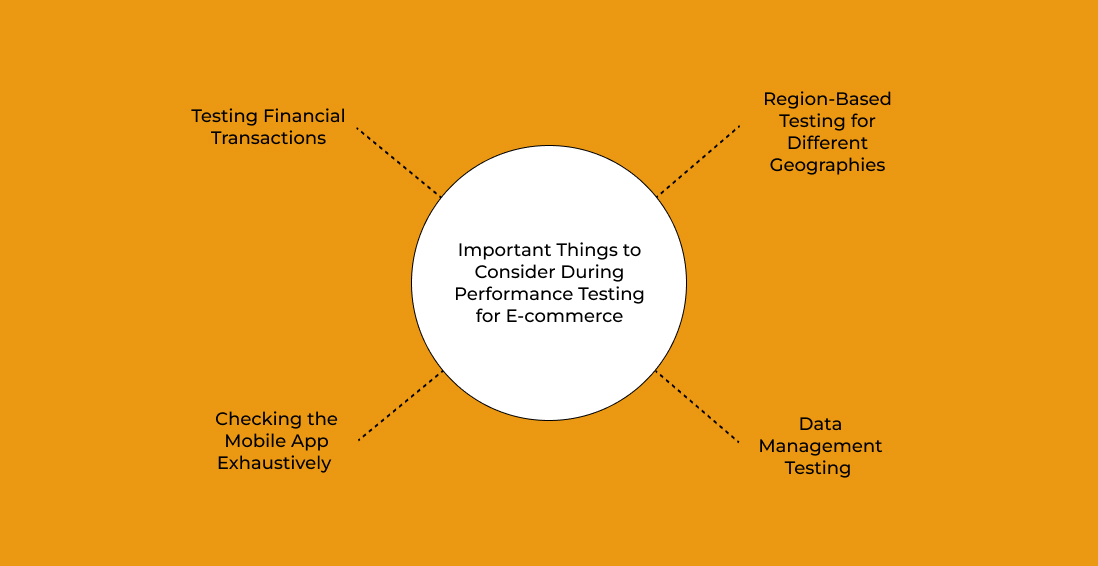
Important Things To Consider During Performance Testing For E-commerce

In this section, we request experts at QA Madness to help us. Specifically, to list some important things that should be considered during performance testing.

1. Testing Financial Transactions

One area where things can go wrong is in financial transactions. With so many people using the same platform at the same time, testing becomes necessary. You need to test to ensure that every transaction is going through.

Integrations with Payment Gateways, the ERP, and Inventory Management Software are all areas that should be covered under this software testing services.

2. Checking The Mobile App Exhaustively

Mobile app testing perhaps constitutes one of the most important verticals for Performance Testing. How does the app perform?

Is it SEO friendly?

Is there a compromise in the graphics?

These are the common issues that mobile app testing will help resolve.

In addition to the app, the mobile version of the E-commerce platform’s website also needs to be tested rigorously.

3. Region-Based Testing For Different Geographies-

If you are starting an e-commerce business, you are looking at a truly global audience.

This is why you need to make sure that the internet protocols of the different countries are not interfering with how the customers in those countries are engaging with your platform. Changed domain URLs, IP addresses, and other rules and regulations need to be considered.

4. Data Management Testing

Any successful E-commerce ecosystem is incomplete without integrated data management. For an E-commerce platform, data is the lifeblood that helps all its verticals- marketing, sales, and CRM.

Performance Testing needs to ensure that the data collection, cloud storage solutions, and the final outputs are ready for systematic generation.

The Three KPIs Of Performance Testing As Stated By QA Madness-

The Three KPIs Of Performance Testing As Stated By QA Madness

While there can be multiple KPIs that software testing services can help E-commerce brands with, QA Madness states that the following are the three major ones. They refer to the same as the three ‘S’s of their Performance Testing goals.

A. Speed

When it comes to speed, we are referring to the speed of the website, the mobile version of the web, and the mobile application. It also includes the speed with which users are progressing from one page to another on the app and the website.

The higher the speed, the better will be the user experience. This combines to deliver the best sales and revenues for an E-commerce platform.

B. Scalability

You do not want your website and app infrastructure to be so weak that it crashes only after a hundred visitors. You’re E-commerce website and the app must go under a test for scalability to handle massive loads all at the same time.

This will help you provide a fluid experience to millions of users and potential customers all at the same time without compromises.

C. Stability

A lot can go wrong on an E-commerce website when it is put under stress. Graphics can fall out of place and payment gateways can collapse. You never want the users to experience these problems on your platform.

An E-commerce platform needs to be stable all the time, with or without load. Performance Testing seeks to build the stability of an E-commerce platform.

What Do Experts Have To Say?

What Do Experts Have To Say

There is no set rule as to when an E-commerce platform should go for Performance Testing. Some believe that it should be done at the early stages of development.

Others believe that it should be done once the development of the platform is complete to identify the loopholes and then plug them in accordingly.

No matter when you get them done, Performance Testing is essential for your E-commerce platform. If you want to create a highly optimized and result-oriented business, this is a great investment to make.

If you have any other questions on software testing services or mobile app testing, feel free to ask them. Use the comments section to drop your queries. We will once again request or reach out to our friends at QA Madness to help you out.

What Happens With A Lack Of Thorough Test?

Not performing performance testing for an E-commerce platform can get you in a lot of trouble. Your site is live; suddenly, hundreds or thousands of people have started using it!

What could possibly go wrong?- Well, without performance testing, things will go downhill really quickly. So, let’s see what could happen when not to perform performance testing.

Crashes And Slowdowns

If your E-commerce platform hasn’t been tested for scalability, it could easily crash when too many users try to access it. A slow website or app not only frustrates users but also drives them away.

No one likes waiting for pages to load, especially when they’re trying to make a purchase. The result? A major drop in sales and a tarnished reputation.

Failed Transactions

Think of users wanting to purchase an item and their transactions fail. Users will not be ready to trust your platform anymore.

This is why performance testing is important as it ensures that all financial transactions are smooth on your site even when there is heavy traffic.

Poor User Experience

Have you ever been on an app or website that lags, has images that don’t fit, or feels unresponsive?

It’s not fun. The UI/UX of your platform can feel the same way without performance testing.

This gives a very unprofessional impression and will make people leave your site out of frustration (high bounce rate).

Increased Costs

Skipping testing might appear to be a good way to keep some money in your pocket, however it will actually cost you more in the end.

If your site crashes during a big sale or promotion, the time and expense of getting those issues fixed after the fact will likely be substantial. Plus, if your site is down for any longer period of time, you’ll be losing out on all that potential income.

Safety Not Guaranteed!

No matter what app you’re building, you’re likely going to be handling some sort of user data.

Whether it’s a login and password or more sensitive financial or health information, users need to know they can trust you with that data.

What About The User’s Interest

Finally, one of the most significant risks is losing users’ trust. If your platform crashes, slows down, or declines a transaction, for instance, and that happens to some users, they will probably never come back.

Even if you fix everything afterward!

When people’s trust is broken, it’s very hard to be rebuilt!

Read also:

A passionate writer and an avid reader, Soumava is academically inclined and loves writing on topics requiring deep research. Having 3+ years of experience, Soumava also loves writing blogs in other domains, including digital marketing, business, technology, travel, and sports.

View all posts

Leave a Reply

Your email address will not be published. Required fields are marked *

Related

content marketing

Required Content Marketing for Your E-Commerce

According to HubSpot, in 2019, 75% of the world's companies used content marketing and found it more efficient than other ways to attract customers. Small businesses with up to five employees predominate among them. The fact is that young companies with budget deficits, in contrast to large market players, prefer to invest in useful content, offering users detailed and objective reviews. Popular sites for content marketing: Blogs on a store's website or a third-party site; video channels; thematic forums; affiliated websites. A blog on an E-Commerce site may include product reviews, sales leader ratings, interesting case studies, recipes and application examples, detailed answers to customer questions, stories about creating a product line and other useful content that will show your expertise in this subject. YouTube channel is an absolute must-have for shops, whose products can be spun in the hands, show in work and express their impressions. For today YouTube is a search engine where you can find answers to almost any questions. Tell your customers which bike is best for the city and tires for the ice. And you'll notice how customers will reach out to you. Thematic forums and partner sites are the right places to post quality content, where you can demonstrate expertise in your niche. User-generated content of the E-Commerce E-commerce is an excellent platform for generating content by users and customers. Reviews, Q&As, photo and video reviews of products provide an opportunity to receive unique and useful content almost for free. It's enough only: simplify registration; add authorization through social networks; abolish premoderation; motivate users to communicate and express themselves; ask to bark, share in social networks; provoke discussion; to give bonuses for comments or reviews. The advantage of content marketing can be considered an increase in the image and customer loyalty due to the trust in the expert opinion of the store. With the same level of traffic to useful content and to the selling page, the content gives the best conversion into sales. If your niche is not yet engaged in content marketing, you have a great opportunity to become an expert and leader in their field. The disadvantage of this method of attracting clients in high labor costs and the long-lasting effect of investments. But during the regular publication of quality materials, the cost of each client involved is constantly falling, which makes content marketing profitable in the long term. Criteria for the effectiveness of content marketing Google Analytics, together with E-Commerce reporting, allows you to track all quantitative and qualitative indicators of content marketing efficiency: viewings; malfunctions; time on the site; number of subscribers; likes, reposting, comments; returns to the site; lids and sales; conversion rate; marketing costs. Sales and lids are just one of the criteria for efficiency. Much more emphasis is placed by experts on the involvement of the audience, which is subsequently converted into sales. Read Also: 7 Proven Marketing Tactics to Increase your ROI in 2018 Creating Successful Mobile Games: What You Need to Know

READ MOREDetails
ecommerce store

Strategies for Running a Pet Supply Ecommerce Store

In the past few decades, there have been major changes in the world and our digital surroundings. While the geopolitics and social interactions of the world are in constant flux, since the beginning of the 21st century, there have been other types of changes that have occurred. Most of these alterations have come from the rise of Internet technologies around the globe. The web has totally revolutionized the world, from the way people interact with one another to the changes in the job market. The most important driver of the economy in the 21st century is the Internet! Everything from local businesses to billion-dollar corporations uses web-based tech to survive. One part of the economy that the Internet has totally transformed is retail. Retail has in large part shifted to e-commerce, and people from around the world have been starting their own e-commerce stores. Starting Your Own Ecommerce Store There are numerous reasons why people start their own e-commerce stores, from the flexibility of lifestyle it provides to the potential to have a lucrative business. There is a myriad of products, which can be sold online. However, finding a niche in your products is a sure way to be successful. This is why running a pet supply eCommerce store is such a great idea. People love their pets and pay serious money for them, so pet supplies is an excellent niche that will certainly lead your company to earn immense revenue. However, if you want to be truly successful, you need to see that your organization will stand out amongst all the other e-commerce stores. Learning How to Set Up Your Business Once you decide to get a website for your online store, one of the first steps is to invest in a robust and user-friendly e-commerce website. This involves selecting a platform, which will allow your website to look professional, run effectively, and will enable you to organize your products and services. After your site has been launched, the next step should involve designing and executing a strong Marketing Campaign on various digital platforms. You need to ensure that your E-commerce store highlights the hero products of your brand. For example, if you have an extensive range of liver supplements for dogs, you need to ensure that you are placing these medicines on the banner of your E-commerce store page. This will help customers identify the same and click on the page that will take them directly to checkout. The marketing campaign should aim to create a holistic and 360-degree digital ecosystem. This ecosystem should reinforce the belief and experiences of the users. For example, your e-commerce platform should be linked to your social profiles and vice-versa. This will help redirect traffic from different mediums at all times. You would also want to adopt a creative content marketing strategy. Your e-commerce website needs to be- SEO optimized. Linked to Social Media Accounts Have a great blog section (Inbound Marketing) Be optimized to run Google Campaigns. Learning about these numerous facets will allow you to effectively market your e-commerce site and will let you display your brand to the world. Final Thoughts: As the 21st century continues to progress, running an e-commerce store will become a more popular career option. In order to be successful in this industry, you need to set up an excellent site, and effectively build your brand with a quality marketing campaign. Read Also: Recognizing How Important Inventory Management Is To Your Ecommerce Store Magento Vs. Shopify: Which Is Best For Your E-Commerce Store?

READ MOREDetails
Digital Marketing Agency

5 Questions To Ask Your Digital Marketing Agency Before You Start Working

In the past few years, brands, regardless of their shape and size have started understanding digital marketing. This means that convincing a majority of them about the advantages of digital marketing has ceased to exist in most situations. You need to do thorough research when choosing a digital marketing agency that you need to partner with. If you are starting from scratch, you need to go via Digitech Web Design, a leading agency that can help you with everything from designing your business website to taking care of your SEO strategies and plans. In 2020, brands are faced with a new challenge- which agency to partner with! Digital Marketing agencies are propping up left, right, and center. While everyone claims to be the best at what they do, it is for brands to be sure of their abilities. In this article, we are going to help brands get on board the best digital marketing agencies as partners. However, before we get to the questions, brands should ask agencies, let us first look at some of the challenges of the same. Challenges to Hiring the Best Digital Marketing Agency for your Brand Every business is unique. It has its own sets of challenges. In terms of priority, some businesses want to concentrate on one aspect, while others look to do something else. It is important that your internet marketing agency understands your needs and requirements as a business. Many brands feel that every digital or internet marketing agency offers the same. However, that is not the case. If you want to work with a complete 360-degree agency, you will have to shell out a premium. Therefore, it is essential to work with a skill set, which you feel would be most helpful for you at a specific time. A creative agency will tell you that it is all about branding, logo, design, and language. An agency geared towards social media would want to focus on just that one aspect. You need to team, which amplifies your complete digital performance at all levels. List of 5 Questions to ask your Digital Marketing Agency before you start 1. What is their area of Expertise? It is essential that you honestly ask them about what their area of specialization at the very start is. Like we already mentioned, while some have a great social team, others might boast of a brilliant SEO team. Depending on what you want to proceed with for the next year, you need to ask them about their different verticals in the organization. 2. What are Budget and Fees? At the end of the day, money matters. If you are looking for a highly-skilled, specialized agency, you need to shell out a good amount as retainer every month. However, if your agency helps you increase your sales and revenues multiple times, you will not feel the pinch. Try starting with a smaller agency to understand those basics and then proceed with the bigger ones. 3. What are their Credentials and Past Work Records? Many brands feel secure when they see that an agency has handled clients in the past from their niche. While this is a great starting point, you should not let your options be limited by just this fact. If they have worked with a business of a similar nature in the past, then they are aware of all the challenges, strategies, and processes, which will be required in the case of your business. 4. What are their Marketing Inputs about your Brand? Most agencies will ask you about your pressure or pain points and then proceed to offer solutions accordingly. You can use this to ask them about larger marketing and sales goals. This will help show you how much they are aligned with your brand. It will also demonstrate whether they understand your issues and are willing to address the same with their skills. 5. What is the Timeframe for seeing Results? You are only working with an internet marketing agency because you want to start seeing results. There is always an expectation involved. Do not fear or feel embarrassed in communicating the same with the prospective agency. This will allow them to assess their performances and see whether they have the capability to fulfill your expectations. The Final Word It is essential that you proceed with these five questions before signing on an internet marketing agency. This will allow you to structure your expectations accordingly. A good digital agency can be a great asset to a brand. However, on the flip side, if you do not get the best agency, you will end up losing money. Read Also: 5 Most Common Digital PR Mistakes And How To Avoid Them How to Empower Your Small Business through Digital Marketing? Why Should You Hire a B2B Digital Marketing Consultant?

READ MOREDetails