













How To Become An Ultrasound Technician? – Steps To Follow

by

14 November 2024

Job & Career

How To Become An Ultrasound Technician

How to become an ultrasound technician?

To become an ultrasound technician or medical sonographer, you must at least have an associate degree in sonography.

Moreover, you can also pursue a Diploma or Bachelor’s program. Even if you have a degree in any other healthcare field, you can pursue a degree in sonography. 

In this article, you will learn how to become an ultrasound technician or a medical sonographer. Moreover, this article will explain the role of this position. 

Apart from that, you will learn the roles, responsibilities, and specializations of an ultrasound technician. Hence, to learn more, read on to the end of the article. 

What Is the Job of an Ultrasound Technician? 

What Is the Job of an Ultrasound Technician

An ultrasound technician (medical sonographer) helps doctors and other medical professionals diagnose conditions through medical imaging. Here, the medical sonographer ensures that the diagnosis is precise, non-invasive, and pain-free. 

For example, an ultrasound technician can help expectant parents see the first images of a child. Generally, these healthcare workers work in teams. Their job includes detecting health conditions like clogged arteries, enlarged spleens, etc., that are potentially life-threatening.  

Basically, the ultrasound tech performs sonography by examining different processes of the human body. Apart from that, they check organ functions with the help of the sonography device. 

Here, they place a camera-like probe on a patient’s skin. This probe then records images and videos. Then, the ultrasound technician passes the patient data to the physician who ordered the test initially. 

Currently, as of 2024, an ultrasound technician is one of the most in-demand jobs. 

What Is Sonography?

Sonography uses sound waves to record and create images of a patient’s internal organs. Basically, it is a surface-level recording method that does not use radiation to create images.

Apart from that, some ultrasound technicians perform prenatal ultrasounds. However, you can use and apply sonography in many more ways in healthcare

For instance, sonography offers you a view of the function of the heart and blood vessels. Also, you can find out whether a patient has potential dysfunctions of abdominal organs.  

Hence, if you want to be an ultrasound technician, you must specialize in any one of those areas. 

Roles and Responsibilities of an Ultrasound Technician

Roles and Responsibilities of an Ultrasound Technician

If you want to work as an ultrasound technician, your task is more than just operating high-tech equipment. Here, you even need to explain various procedures to patients and answer their questions.  

For instance, you must operate and maintain different imaging equipment. Additionally, you need to record the patient’s medical data. Moreover, the job also requires you to analyze results before the doctor starts diagnosis. 

However, you do not need a medical degree to become an ultrasound technician. Despite that, it is one of the least stressful roles in the medical field. Apart from that, you will also get good pay if you are good at your job. The best part is that the job is in high demand in the medical field.  

Generally, in the United States, you will need to work in hospitals as an ultrasound technician. Apart from that, depending on the needs of your employer, you might work in a physician’s office, medical labs, or outpatient care centers.  

Basically, in most cases, you will be a part of the team, which consists of doctors, registered nurses, and medical professionals. Furthermore, the ultrasound tech salary ranges from $60,000 to $90,000 annually (approx.) 

On the other hand, there are some drawbacks too. This is because, in most cases, you might have to work in an environment with low light. Apart from that, you need to continuously stand and operate the machine. Moreover, in case of high demand, you will need to work on weekends and evenings as well. 

How To Become An Ultrasound Technician? – Steps To Follow 
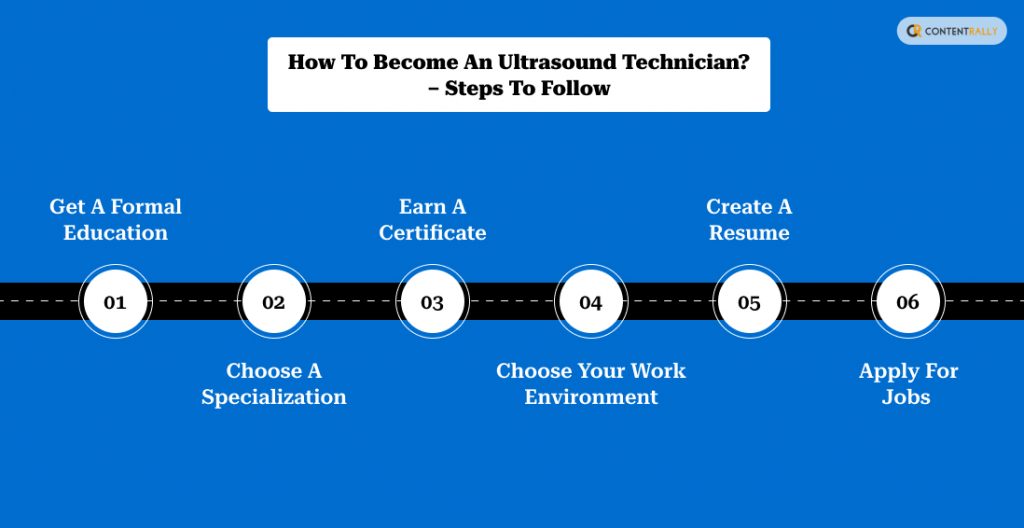
How To Become An Ultrasound Technician? – Steps To Follow 

You will need approximately two years to become an ultrasound technician. In some cases, you might require a year more.

The following are some steps you must follow to become an ultrasound technician: 

1. Get A Formal Education 

If you want to become an ultrasound technician, you must receive a degree in the healthcare field. Although it is compulsory to have a degree in medicine, doing so will give you an advantage. Apart from that, you can also consider getting a degree in biology, health sciences, anatomy, and chemistry. 

For instance, you can choose to pursue a diagnostic medical imaging course that focuses strongly on sonography. On the other hand, you can also consider pursuing a bachelor’s degree or an associate degree. 

2. Choose A Specialization 

The healthcare sector is vast, and there are various fields in the sector. Hence, you must choose your specialty beforehand.

For instance, you can choose parental health or other specializations like cardiovascular field, abdominal, breast, neuro, gynecologic, and more. You will get an overview of major specializations in the next section of the article. 

Basically, you can specialize in more than one area. After you determine which specialty you prefer more, you can focus on earning proper certifications. 

3. Earn A Certificate 

To become an ultrasound technician, you have to earn technical certification after you complete your specialization. Generally, there are three recommended ways to complete your certification: 

  • American Registry for Diagnostic Medical Sonography (ARDMS
  • Cardiovascular Credentialing International (CCI
  • American Registry of Radiologic Technologists (ARRT

Here, you must choose one of these three since each of them has its own program and course. Any one of these programs will prepare you for a career in sonography.

Moreover, each program has its own requirements and timeline. Also, you need at least a year to complete your certification. 

4. Choose Your Work Environment 

Once you start working as an ultrasound technician, you will have enough opportunity to choose your work environment. For instance, you can work in a hospital setting, continue your private practice, or work in a medical laboratory.  

Therefore, when you are looking for career opportunities, you can search based on the environment where you prefer to work. 

5. Create A Resume 

After you choose your work environment, you must research your potential employers. Then, you need to choose your work settings and job openings. Once you do that, you must begin working on your resume. Here, you must consider getting some resume tips from a professional. 

Here are the factors you must consider when you are building your resume: 

📝Formal Education 

Here, you must include the name of your school, the degree, and the dates. However, do not include dates if you have graduated more than three years ago. Moreover, you can include details about your experiences with professional organizations and other leadership opportunities. 

📝Professional Experience 

In this section, you must describe your previous roles and responsibilities. However, if you have just finished school, include positions irrelevant to the healthcare field. Also, consider listing any relevant internship experience or coursework in a similar field. 

📝Skills 

In the skills section of your resume, highlight your personal and technical abilities. Moreover, to work as an ultrasound technician, here are some professional skills you must mention: 

  • Communication skills 
  • Organizational skills 
  • Attention to detail. 

Apart from these skills, list down your skills in sonography and your knowledge of dealing with machines. 

📝Certifications 

Include relevant certifications and their dates. This will show that you have field knowledge and the professional drive that potential employers are looking for. Moreover, some positions might also require you to have certain certifications. 

6. Apply For Jobs 

Once you complete your resume, you can apply for jobs in sectors that appeal to you. However, when you are applying for a certain position, make sure to align your resume and cover letter based on the position you are applying for. 

Apart from that, you can also consider building a network in the healthcare field. Thereby, you can get insights into hospitals, medical clinics, and healthcare organizations. As a result, you will have more information about openings. 

How to Become an Ultrasound Technician? – Major Specializations 

How to Become an Ultrasound Technician? - Major Specializations 

An ultrasound technician has exposure to four different sonography specializations. Also, each specialization has multiple sub-specializations.

The following are the major specializations you can choose from: 

A. General Sonography 

Here, you must know how to image internal organs, like liver, brain, kidneys, etc. The following are the subspecializations in this field: 

  • Neurosonology 
  • Obstetric and gynecology sonography 
  • Abdominal sonography 
  • Breast sonography 

B. Cardiac Sonography 

In cardiac sonography, you must specialize in taking images of the heart using echocardiography. The following are some of the major sub-specializations: 

  • Pediatric echocardiography 
  • Adult echocardiography 
  • Fetal echocardiography 

C. Vascular Sonography 

Here, you must become a specialist in taking images of veins and arteries. Basically, the goal is to look at the flow of blood and the status of blood vessels. 

  • Peripheral vascular sonography 
  • Carotid sonography 
  • Abdominal vascular sonography 

D. Musculoskeletal Sonography 

In this case, you need to be a specialist in getting images of muscles, tendons, joints, and ligaments.

Here are some sub-specializations you must consider: 

  • Soft tissue sonography 
  • Tendon and ligament sonography 
  • Joint sonography 

Pursue A Career In Sonography Now

Hence, you know how to become an ultrasound technician. First, you need to get a formal education in the healthcare field and then work on your specialization. After you specialize, you must get a professional certification. Consequently, you can apply for jobs as an ultrasound technician or a medical sonographer

Do you have more suggestions on how to become an ultrasound technician? Please share your ideas and opinions in the comments section below. 

Read Also:

A passionate writer and an avid reader, Soumava is academically inclined and loves writing on topics requiring deep research. Having 3+ years of experience, Soumava also loves writing blogs in other domains, including digital marketing, business, technology, travel, and sports.

View all posts

Leave a Reply

Your email address will not be published. Required fields are marked *

Related

In-Demand Jobs

Top Four In-Demand Jobs in Australia

I wish someone had told me what the top jobs were, so I hope this one helps anyone who hasn't found their ideal job yet. No matter how much you do not want to believe, our economy continues to be in a slump. It happened with the dot-com bubble, and it happened with the recent financial crisis, and unfortunately, it will happen again if nothing is done about it. And because of this, it becomes very important to start having a substantial second source of income. One way to achieve this is to improve your skills and become one of those in-demand professionals in Australia. If you are looking to migrate to Australia, it's a good idea to know what type of job you're aiming for. Here are the current top 4 in-demand jobs in Australia. 1. IT Consultant With technology advances constantly happening around us, companies can't help but implement the latest technologies in their day-to-day running – and this is where IT jobs in Australia come into play. IT consultants are in high demand from implementing new systems to assisting companies in migrating to the cloud. There has even been a growth of software developers looking for work as well. Smart businesses know that they need a strong IT department in place for them to achieve their goals. 2. Project Managers Project Managers are in high demand, and they can earn some big bucks. If you're a bright, talented graduate with an eye for detail, this could be a career path that could be right for you. In Australia, the average salary for a Project Manager is between $70,000 and $100,000. Where will this lucrative field take you? How much money can you make as a Project Manager in Australia? According to the latest figures, there has been a 21% increase in the number of roles advertised as requiring PMP certification since this time last year. The Australian job market is becoming increasingly competitive, with a real thirst for professionals that can bring real value and expertise into an organization. Particularly in the management consulting and IT fields, there is a big demand for Project Managers, which is no surprise given that project management is probably the most valuable skill you can acquire as a professional. 3. Recruitment Consultants In today's economy, there's more competition than ever for jobs in Australia. A large percentage of job ads are filled by recruitment companies that can be expensive to hire. In fact, many job seekers spend up to 20% of their first-year salary on recruitment fees. Jobs like Recruitment Consultants, Sales Managers, Marketing Managers, and Lawyers are top of the list of the most desired jobs in Australia right now, according to the latest data from jobseeker.com.au. This has been a trend for over 15 years, with a recent dip in the last two years where they went down to the ninth spot. 4. Business Development Managers Business development managers are in high demand as the economy shifts towards more service-related roles than ever before, finds JobsEye, an Employment Research Company that tracks the most in-demand positions. Data from Henry's Job Outlook has identified top jobs for 2018 in Australia. The research finds that there will be 28 percent growth in business development positions, which is expected to be the highest amongst all occupations. Read Also: Healthcare Jobs That Will Be Most in Demand 2020–2025 Why You Should Use A Recruitment Agency To Find Your Next Medical Job

READ MOREDetails
Enhance Your Career In The Field Of Social Work

Tips To Enhance Your Career In The Field Of Social Work

Everyone struggles sometimes. While some people might be facing issues in their personal life, others might be unhappy with their careers. There comes a time in your career when you get bored with work. Things might seem monotonous, and you might want to switch gears. Changing things is a natural consequence of routine, and many people switch jobs for greener pastures. According to research, an adult shifts jobs approximately 11.7 times between 18 and 48. However, doing so is not child’s play. Some professions are even more complicated to navigate. A career in social work is one of the broadest in the world. Furthermore, it is unhealthy to keep working in a toxic position. And social workers are more vulnerable to burnout and workplace stress. Social work is flexible with an interdisciplinary nature. There are countless career opportunities to help others and improve their lives. What Do Social Workers Do? Generally, social workers help others make a meaningful change in their lives. Therefore, they may work in several positions. There are three subsets of practice for social workers. They may work at the micro-level to focus on the issues of individuals. Or they may focus on the big picture and resolve the problems of communities and social groups. Some social workers help support groups and head task forces. So, they may work in hospitals, schools, or have private practices. Tips To Make The Most Of Your Social Service Career: Now that you have entered social work, let’s move on to other matters. How can you advance your career? Read to find out more about this. 1. Get An Advanced Degree In Social Work: Like all other professions, getting a graduate degree will help you climb the career ladder. With a CSWE online MSW degree, you can become a leader in social health. The best part is that these degrees are available online. So you can manage your course load and study at your own pace. But, do your research before you choose a program. Look through online rankings and think about the pros and cons of each degree. You can also gain experience while studying. Interestingly, some supervisors even offer stipends and scholarships to their employees. 2. Develop Your Skills: Research suggests that employers prefer people with transferable skills. However, social workers struggle to develop these skills. Therefore, it is necessary to hone these skills to advance in your career. Employers are looking for people with excellent communication skills, leadership capabilities, and technical skills. 3. Join A Network: Joining an organization can improve your experience and skill set. These social work organizations connect people to leaders and graduates. Many such organizations host events and seminars for members. Most of them also offer discounts to members. For example, the American Association for Geriatric Psychiatry serves geriatrics patients and provides collaboration opportunities to professionals. 4. Get Experience To Contribute: Experience is necessary for career development. This exposure gives you valuable insight into social work and the responsibilities of a social worker. However, you should get a diverse experience. Doing so will contribute to your career prospects. Try out new things, and gain experience in several positions. 5. Do Some Research: While experience is necessary, research and knowledge are also vital to improve job prospects. Seek out classes in diverse fields and participate in independent studies. You can work with faculty members and researchers to make yourself more employable. 6. Get A Mentor: It is not possible to do everything on your own. Therefore, you should ask experienced professionals to help you grow further. These people bring many years of experience and have inside knowledge about everything. Furthermore, they can also help your prepare for life challenges. 7. Network And Enroll In Professional Development Opportunities: Most institutions organize events to increase knowledge and develop skills. You can enroll in workshops and courses to build your network and connect with others. Networking can improve your job prospects as well. Building relationships with other professionals can help you build enduring relations with others. 8. Take Some Time Out To Reduce Stress: Self-care is vital for the health of social workers. You have to make time for yourself to reduce stress and avoid burnout. Take some time out to connect with friends and family every once in a while. 9. Always Act Professionally: Social workers are witnesses to many embarrassing and humiliating things about their patients. Therefore, it is vital to follow ethical standards at all times. Handle your patient with dignity and the utmost care. But, Why Work In Social Services? If you are thinking of making a career change, then social work is the profession for you. On average, 6.2 million workers make a career change per year. Working in social services can put things in perspective for you. Not only is social work fulfilling, but it is also meaningful. Social work is a growing field, and it is expanding rapidly. According to the Bureau of Labor Statistics, demand for social workers will increase by 16 percent in the next few years. Therefore, there will be 110,000 new jobs until 2031. Furthermore, the pay is not terrible either. According to BLS, the average salary is $67,000 per annum. And your wages might improve with additional certifications.  What Is The Next Step? Now is the time to begin planning for your future. Therefore, start looking for employment opportunities. You can also enroll in graduate programs to improve your prospects. With a specialized degree in social work, you can reach the pinnacle of the career level. Utilize these tips to make the most of your social work career. However, never forget why you chose to enter this profession. Read Also: Top 7 Reasons the Medical Field Will Always Be In Demand B.Sc. Agriculture- An emerging career option in India Top Non-Physician Career Opportunities in the Healthcare Sector in 2021

READ MOREDetails
Traits That Any Professional Should Aspire For

Here Are The 10 Traits That Any Professional Should Aspire For

Each profession demands certain types of talents and skillfulness. However, it's critical for everyone in the workplace to possess a set of general professional qualities, demonstrating well-rounded competence. In addition, we are living in a highly competitive space where people constantly fight for a spot. Alternatively, we continuously seek ways to enhance our skills, striving to stand out in our chosen career paths. As long as you keep this spirit, you can overcome most job challenges. With a dedication to continual learning and responsibility, professionals can stay ahead on the career ladder. Further, they are more prone to new opportunities as they can make a lasting contribution to their industry. Top 10 Professional Qualities To Keep In Mind Aspiring professionals must strive to develop diverse qualities that can ultimately impact themselves, their clients, their colleagues, and the organization. This is true for everyone, whether you are a seasoned or a fresh graduate. Moreover, success and progression in one's career are not limited by age. We all have different success timelines. But as long as you have a growth mindset and a solid set of qualities, you can go a long way. While some are lucky to be born with the “wow” factor, others do not. This is why many enroll in professional behavioral coaching. After all, being a so-called professional can be learned. Read on as we discuss the significant traits you should aspire for! 1 Eager To Learn If you are familiar with Tim Clarke’s book, “4 Stages of Psychological Safety,” you would know how crucial it is to develop a learner mindset. You are more likely to encounter many clueless moments at work if you are a new hire. A person who is willing to learn can go a long way. Your eagerness can make you ask questions, make mistakes, and ask for help without fearing embarrassment or humiliation by your peers. 2 Can Remain Calm Under Pressure And Stress Not all can ace this one. Staying composed under stressful scenarios implies how professional an individual can be. Rather than zoning out or focusing more on the chaos, remaining poised allows you to maintain healthy relationships. This is because intense situations often trigger most people. They tend to do things they must not do. 3 Being Collaborative And Responsible If you are working on a bigger space, you must have an aura that can make you likable and pleasant to work with. Mastering such quality can get you more projects. A quick tip here is to allow your coworkers to share their insights. Let them contribute. This way, you can build an imaginary string that binds everyone on the team. 4 Exhibiting Leadership Abilities It does not matter whether you are not the CEO yet. An exemplary professional can lead a team effectively. Fortunately, various programs can help you with this particular skill. For instance, you can apply for executive coaching programs that provide psychological safety exercises. Also, professionals who can lead are more likely to receive promotions, better job offers, and pay raises. 5 Can Operate In The Highest Level Of Integrity Whether in a personal or professional setting, integrity is essential to practice. Cognitive behavioral coaching techniques can help you succeed in being trustworthy and practicing honesty regarding decisions. Having integrity makes people feel safer in letting you work on major assignments involving private information. 6 Self-Motivated And Solution-Oriented Most bosses and executives appreciate employees who excel at tasks without supervision. This is because a self-motivated individual tends to stay on track more than those who are not. On top of that, a professional must be solution-oriented. When an issue arises, these people will provide proactive solutions, not band-aid ones. They can offer practical ways on how to fix the problem. 7 Has A Positive Attitude No one prefers to work with a consistently pessimistic individual. Your positive attitude can contribute to a healthier working environment, inspiring others to do and feel the same. Aside from that, optimistic people are most likely to find solutions rather than dwell on the situation. This can help achieve more company goals in the long run. 8 Confident Again, let us talk about the book “The Four Stages of Psychological Safety” by Timothy R Clarke. His book’s first stage states that humans desire acceptance. When we feel valued and appreciated, we tend to be more confident. This highlights the importance of choosing a workplace that values inclusive. Your coworkers must operate without hate and discrimination. 9 Comfortable With Failure While we strive for perfection, it's inevitable to encounter failure at times. In the complex world of entrepreneurship where many things can go wrong, an employee capable of transforming negatives into positives can be invaluable. Being comfortable with failure can be tough to master. But once you do, you can become unstoppable. 10 Equipped With Executive Coaching Training If you're eager to excel in your chosen field, it would be prudent to invest in training programs that can enhance your workplace performance. A leadership coach can help you navigate the intricacies of the corporate world. For some, the concept of psychological safety in the workplace may be unfamiliar. To explain, psychological safety training is a framework that assists businesses and organizations in attaining their goals while supporting all members. Fortunately, a wide variety of executive coaching services are available to cater to the needs of every professional. Here's a list to consider: Executive Leadership Coaching Performance Management Coaching Corporate Coaching Solution-Focused Coaching CEO Coaching Career Coaching Executive Business Coaching A reputable coaching organization recognizes individual progress. For instance, they can give you behavioral coaching certification that you can add to your resume. This shows how you are eager for growth and development. Conclusion We can make significant professional contributions, particularly if we maintain a growth-oriented mindset and embrace coaching behaviors. Understanding how to foster psychological safety at work can be challenging. A well-respected coach can help you with that. These experts provide the necessary tools for workplace success. Moreover, they can serve as your accountability partner, aiding your personal and professional growth. Additionals: Fast-Track Your Career: 7 Things You Should Know About Executive Coaching Is Investment Managers A Good Career Path In 2021? Is Medical Assistant A Good Career Path In 2021?

READ MOREDetails