













Building Your Conceptual Skills A Guide for Career Growth

by

09 September 2024

Job & Career

conceptual skills

“The ability to work with abstract ideas & concepts-” or, how Americal social psychologist Robert Katz would describe conceptual skills.

In fact, he said it was one of the basic skills which every manager should have!

Interestingly when psychologists test an individual’s aptitude of whether they will be a good leader, conceptual skills are one of the top meters of measurement.

Now, what are conceptual skills?

Is it just some abstract word? Or is there a scientific definition of this soft skill required from their employees by corporations nowadays?

Most importantly!

Can you hone your conceptual skills as an adult again?

Without any further ado let’s discuss the improvement areas required to build a conceptual skill, and the different means by which you can improve it.

What are Conceptual Skills?

What are Conceptual Skills_

Everyone can decipher something simple and covert, but it takes special skills to understand the deeper meaning behind abstract issues.

Most importantly, if these abstract matters pose a challenge and will require impromptu solving.

conceptual skill is about leaping beyond the daily mundane activity or being short-sighted. It is about seeing and articulating the bigger picture so that others sense it too.

For example, if you are working on a particular Search Engine Optimization strategy for your new website, you cannot ask for quick results.

You will require a long-term vision to see what can happen if you continue with the formula for at least a month or two. 

This skill also requires a fair amount of research and dissection knowledge, seeing beyond the written words and literally deciphering the concept within.

People with good conceptual skills are often good at sales, market prediction, consumer/customer psychology, and chess (during their off time).

Conceptual skill is not a vague word but rather a compilation of eight examples of conceptual skills that you should always be working on.

  • Analysis (there is a difference between seeing & observing what you see thoroughly).
  • Communication (the ability to articulate in understandable words what you observe).
  • Creativity (the ability to observe something with a unique imagination as opposed to everyone else).
  • Critical Thinking (trying to understand what the view is not showing at first glance).
  • Leadership (the ability to show the same to others and help them on that path).
  • Organization (this is not just organizing tangible items but organizing one’s own thoughts & understandings).
  • Planning (Only observation & comprehension is not enough. Enough planning skill is required for proper implementation)
  • Problem Solving (the ability to execute resilience in the face of challenges).

Building Steller Conceptual Skills

Building Steller Conceptual Skills

Do not worry, when I saw everything, I needed to do to build conceptually skillfully, I was also overwhelmed.

Where to start & where to finish?

Most importantly, do I tackle it all at once? Or do I go about it one by one?

To begin with, when you are learning a new skill, you only tackle it in a timely manner. If you try to do everything at once, you do nothing properly. So, it is always better to learn one skill at a time.

However, these are soft skills. How can I learn them like I am learning from a college lesson?

This is also another valid question, do not worry, there are mindful activities, and daily challenges you can pursue to learn these better.

How to Learn Conceptual Skills Better

How to Learn Conceptual Skills Better

Here is a step-by-step guide to begin learning your conceptual skills.

Remember, these skills take time to learn! 

It is not a matter of six months or a year, but a lifetime journey. 

However, there are means in which you can check your progress. One of the biggest ones would be how your lifestyle & work personality changes from the time you begin learning this skill.

Step 1: Know Your Strengths & Weaknesses

Never start with an unknown skill; rather, begin with something that you are already aware of.

A good way to start is by doing a SWOT analysis of yourself.

Begin with marking the things you are good at (among the eight criteria given above), and the ones you need to work on.

If you are hypersensitive & can get easily overwhelmed, then begin with perfecting your strengths rather than concentrating on your weaknesses.

For example, I am anxious, so I began by polishing my creativity skills, which I was already good at. This gave me the motivation to tackle my weaknesses next.

However, if you are a motivated person , begin with targeting your weaknesses. Especially if this is all for interview prep.

Step 2: Do Something Everything

If you have been on a learning journey for quite some time, you must have heard these words of wisdom –

“Consistency is better than striving for perfection.”

Therefore, whenever you of building any skill, the first task is to ensure you do something every day.

Yes, there will be days when you will need more optimal motivation to sit with your skill-building activity. But, if you’re incorporating the activities into your daily routine, you should be able to see changes in time.

Step 3: Real Life Execution

A learned skill is useless if you cannot execute the same. Unfortunately, no one is going to stand with a placard shouting –

“This is your moment.”

Whether it is a situation at home or a conflict in the office, you will have to step out of your comfort zone and step into the challenge.

No, it won’t be easy, but rather a mindful decision you take every day. Before you feel overwhelmed with the idea of stepping in and solving a situation you are not called for, remember –

Everyone feels insecure about their professional skills at some level (no matter the years of experience). 

You could work in the same industry for decades and still face something new. Learning has no end, so find your opportunities in everyday instances.

Conceptual Skills – How to Improve it

Conceptual Skills – How to Improve it

We have already discussed conceptual skills. Now, let’s understand how to improve these conceptual skills.

All You Need is Challenge!
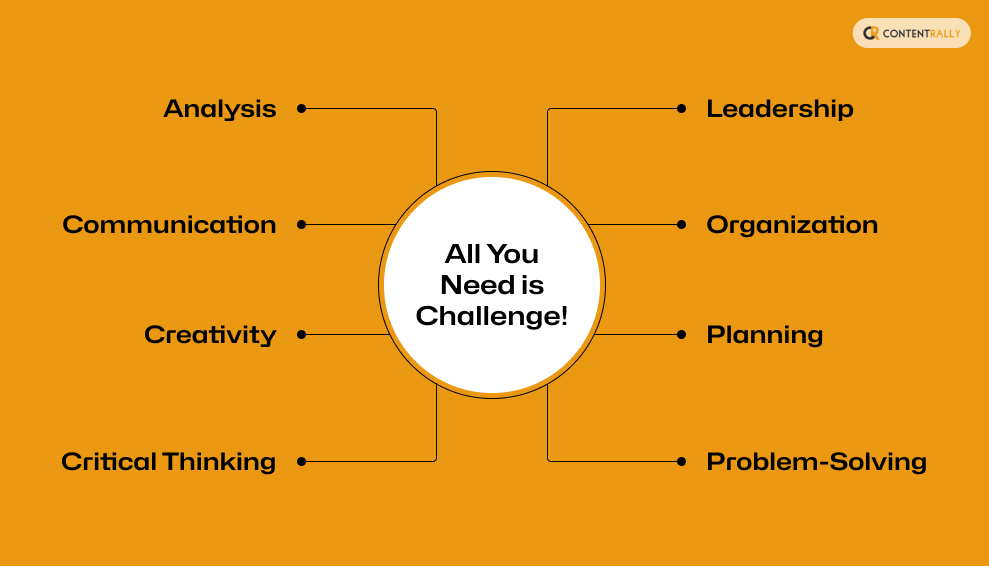
All You Need is Challenge!

Achieving professional success is more than just meeting deadlines or ticking boxes. It’s about mastering the right skills & focusing on conceptual management skills that give you an edge. 

Let’s break down eight essential skills you should focus on—and a weekly challenge of self-intervention for each to help you improve.

Analysis

The difference between seeing and truly observing lies in depth. Analyzing is all about dissecting what you see and finding hidden patterns.

Challenge: Pick one topic or event daily and write a quick summary. Then, dig deeper—what did you notice beyond the obvious?

Communication

It’s not just about speaking or writing; it’s about making your thoughts clear to others. Effective communication bridges the gap between observation and understanding.

Challenge: Practice summarizing complex ideas in simple terms. Try explaining a work concept to a friend with no background in your field.

Creativity

Creativity isn’t just about thinking differently—it’s about connecting the dots in unique ways others might miss.

Challenge: Choose a random object daily and brainstorm five unconventional uses. Push your imagination!

Critical Thinking

Sometimes, what’s not immediately visible holds the key. Critical thinking pushes you to question the obvious and explore hidden layers.

Challenge: Read a news article or watch a documentary. Then, list three assumptions it makes and challenge them.

Leadership

Leadership isn’t just about guiding others; it’s about showing them a clearer path by sharing your unique insights.

Challenge: Each week, identify a workplace situation where you can take initiative. For example, you could guide a colleague through a process or host a quick knowledge-sharing session.

Organization

Beyond tidying up your desk, organizing involves structuring thoughts and ideas efficiently.

Challenge: At the end of each day, spend 10 minutes categorizing your tasks, ideas, and notes. Organize them into clear categories for better clarity.

Planning

Good ideas need solid plans to come to life. Proper planning bridges the gap between ideas and successful execution.

Challenge: Pick a small project this week (e.g., organizing a team lunch or personal task). Break it into detailed steps and set mini-deadlines for each.

Problem-Solving

Life throws curveballs. Resilience in problem-solving helps you bounce back, adapt, and find innovative solutions.

Challenge: Take on one issue nagging you at work or in life. Brainstorm multiple solutions, pick the best one, and act on it.

Final Note!

Incorporating these challenges weekly could transform how you approach your work. The more you practice, the sharper these skills become. 

Building conceptual skills isn’t a one-time task; it’s a continuous journey. Each skill strengthens your foundation for long-term career growth. 

By practicing regularly and embracing challenges, you’ll develop a sharper mind, better communication, and a unique approach to problems. Remember, growth isn’t just about working harder—it’s about thinking smarter.

Ready to level up? Start your first challenge today!

Read Also:

Content Rally wrapped around an online publication where you can publish your own intellectuals. It is a publishing platform designed to make great stories by content creators. This is your era, your place to be online. So come forward share your views, thoughts and ideas via Content Rally.

View all posts

Leave a Reply

Your email address will not be published. Required fields are marked *

Related

Is MedicalDental Instruments A Good Career Path

Is Medical/Dental Instruments A Good Career Path

Is Medical/Dental Instruments A Good Career Path in 2024? How many jobs are available in medical/dental instruments? What are the best paying jobs in medical/dental instruments? Let’s solve these queries in detail. A career in the medical and dental field enables you to engage with other people while helping them feel more relaxed in a setting that can cause anxiety and discomfort. Dentists earn some of the highest salaries in the healthcare sector. The demand for a dentist is also high in every area of the United States. Now, let’s know more about the same below in detail.  Medical/Dental Instruments - What You Need To Know? Dental instruments are tools that dental experts use in order to provide dental treatment. They include tools to surround oral structures, and restore, treat, manipulate, examine, and remove teeth. At the same time, these tools help professionals with enhanced visual access during a dental examination. Those who enjoy working with people and providing dental care can find appealing and fulfilling positions in this sector. The dental industry is booming not only in terms of suppliers but also in terms of its engagements with progressive digital technologies and software. Dentists and dental companies are actively engaging with dental assistant temp agency to optimize their scheduling, record-keeping, and other administrative work. The presence of this trained personnel ensures that you can concentrate on growing your client base and making your practice a success. Now, here are the top eight types of dental jobs that you should know in 2024. Orthodontist Oral Surgeon Periodontist Dentist Dental hygienist Dental assistant Medical biller Medical receptionist. Is Medical/Dental Instruments A Good Career Path In 2024? The answer to this question is an absolute Yes. Dental careers enable you to perform patients’ lives by carrying out procedures that remove pain, prevent future problems, and restore oral health.  The best benefit of this career path is that you can open up your own clinic. Besides, dental assistants provide hands-on help for the dental practitioner. This assistant performs preparatory work such as taking impressions of patients’ teeth, developing X-rays, sterilizing equipment, etc. The rewards that you get both personally and professionally are truly great. You must go for this career path if you are looking for a rewarding future. Some other rewarding career paths are packaged foods, electric utilities, basic industries, precious metals, capital goods, consumer durables, major pharmaceuticals, home buildings, commercial banks, photography, major banks, etc. Benefits Of Working In Dental And Medical Instruments?  There are some benefits in the career path of dental and medical instruments which you need to learn. This is important because there is a wide range of product innovation along with industries.   I am sharing with you some benefits if you are planning to look for job opportunities in dental and medical instruments careers.  Wide Variety Of Career Opportunities  We all are dependent on the people who belong to the dental and medical instruments field similarly numerous organizations are dependent on them. Health care clinics, hospital networks and medical suppliers are dependent on the medical and dental instruments individuals!  There are specific skill sets and education levels required for the diverse job titles in these organizations. There is also a global demand for health care equipment which contributes to the access of international positions in dental and medical instruments.  Working in this career path will help you apply for a lot of international positions which will contribute to your economic and intellectual benefit.  Opportunity For Innovations  In the medical field, scientists constantly try to better the overall outcome of patients through advancements. The medical field changes are integral to this industry as the nonpharmaceutical products.  For example, dental cleaning tools, diagnostic equipment such as x-rays, medical implants and surgical equipment are enhanced so that medical services can be improved.   Patient lives along with significant health care implementation will resolve long-term challenges. They can expect constant care and good integration of medical instruments!  The Outlook Is High  The biomedical engineers and bioengineers are close to the medical instruments market and can expect good salaries. The job outlook of these two positions is defined by the United States Bureau of Labor Statistics (BLS).  By 2031, the medical instruments market will be increasing by 10%! Therefore, the attributes of BLS will greatly increase regarding demand for services for knee and hip replacements.  Requirements Of Working In Medical And Dental Instruments!  There are specific industry requirements being fulfilled, especially because of the employers being aware of the market's need. As a jobseeker, you must learn about the expectations of the employers, accordingly, developing skills for the role!  Education  There are specific educational requirements for most individuals who are working in dental and medical instruments career field. A specific specialization is necessary for operating in this field.  If you are in consulting or sales, you will need to acquire an associate degree while if you are planning to work in a research position or engineering, you will need a bachelor’s degree or a master’s degree thus, a beneficial proposition for you.  Certification  To have medical and technical knowledge, you need to enroll in courses which will provide you with certification. The certification courses are available in professional associations or technical schools.   These certifications are typically beneficial for applying for jobs in dental and medical instruments field.  Training  On-the-job training is an integral part of this industry thus you can apply for your chosen job. You must stay on top of the latest technological advancements so that you can stay related and updated.  You can learn different aspects of this career path, which includes cleaning, repairing, maintaining, and sterilizing instruments quite easily! The devices will help in health, wellness, and biomedical duties!  How Many Jobs Are Available in Medical/Dental Instruments? If you have received an answer to the question "is medical/dental instruments a good career path?" and are considering a career in this field, you might be wondering how many jobs are available. How many jobs are there in the field of dental and medical instruments? The United States' Bureau of Labor Statistics (BLS) says that the medical and dental instrument industry is actively hiring a lot of people right now. Over 100,000 jobs are available in the field. According to the BLS, there will also be an increase of at least 6% in job openings in the medical and dental instrument industry over the next ten years. Best Paying Jobs In Medical/Dental Instruments There are numerous jobs available in medical/dental instruments. Even you can open your own clinic and start earning money by treating patients. Besides, the path to becoming a dentist is pretty straightforward.  Now, there are many jobs available in medical/dental instruments that you can consider, and those are discussed below. Orthopedist To become an Orthopedist, you must have a Bachelor’s degree related to the medical field. You may also need certification in orthodontics, whose duration is three years. So, the duty of an Orthopedist is to examine and provide treatment for anomalies in the oral and dental malocclusions in patients. Other major duties include maintaining treatment records, fitting patients with braces, studying patients’ dental histories, analyzing X-rays, etc. Periodontist A Periodontist treats and diagnoses the gums and bones that surround the jaw. Duties include providing surgical and non-surgical options, performing tissue reductions, developing treatment plans for patients, providing preventive care, placing implants, etc. To qualify for a periodontist, you must secure a Bachelor’s degree and also complete a residency program that focuses on diseases and gum issues. Dentist The dentist is one of the best-paying jobs in the medical/dental instruments sector. A Dentist must earn a Bachelor’s degree, graduate from accelerated school, and take at least four years to complete a full-time program.  These individuals identify and treat the mouth, including teeth, gums, and related fields. The main duties include placing permanent implants, removing teeth, filling cavities, developing treatment plans, analyzing X-rays, and much more.  Dental Hygienist Dental Hygienist provides good oral hygiene practices, clean teeth educate on oral hygiene, and provide dental care to patients. At the same time, he/she must be able to perform additional duties and responsibilities. If you are interested in this career path, then you must require a high school diploma with a dental hygiene degree. This is truly one of the best career paths that you can consider for yourself in 2024.  Dental Assistant A Dental Assistant works alongside a dentist and takes care of all the needs required by the dentist while performing treatments and also taking care of the patients. So, to work in this position, you need to complete a dental assistant program via any technical institute.  Medical Biller Another top-paying job in medical/dental instruments is Medical Biller. This biller collects payments for the procedures and treatments performed by the dentists and other staff. Now, to become a medical biller, you must have a Bachelor’s degree in a related field, and a high school diploma is vital.  Medical Receptionist The virtual dental receptionist works in the dental office to handle common clerk tasks. These include greeting and checking in patients, scheduling appointments, answering phones, etc.  Besides, to work in this field, you require a high school diploma and also a basic knowledge of medical procedures and terminology.  The Final Verdict Is Medical/Dental Instruments A Good Career Path in 2024? I hope you have got the answer to your above question. There are many career sectors in the medical industry, and the demand is also too high. Besides, let me know your doubts in the comment section below if you come across the above-listed information. Keep Reading: Is Medical Specialities A Good Career Path? – 12 Best Jobs Radiant Smiles: A Guide To Different Types Of Dental Implants How to Use Practice Analytics to Improve Your Dental Practice?

READ MOREDetails
legal and compliance jobs in Malta

What you need to know about legal and compliance jobs in Malta

How does a firm keep track of the desired implementation of its rules, policies, standards operating procedures, and regulations? How will it know if it is adhering to the regulatory and legal requirements that are mandatory for the continued running of operations? Individuals with legal and compliance jobs are the ones that assure that these organization matters are in order to avoid responsive actions from regulatory authorities plus ensuring that company policies are well adhered to. Legal and compliance jobs in Malta are the toughest in organizations and require people that are not just thoroughly aware of all SOPs and policies of the firm, but also be updated with the latest requirements and laws for operating in the industry. Legal and compliance jobs in Malta are in demand since it is hard to come across a compliance officer, given its nature, which needs intensive training, in-depth knowledge in the industry, and proper certification as well as the market and law of the land. These jobs are very demanding and they involve so much responsibility, therefore, the population of compliance officers in any given company is very low. Smaller organizations can have just one compliance officer. The minimum academic requirement for landing the compliance job is a bachelor’s degree. Nevertheless, with continuous technology modernization and procedure advancements and techniques of running the business, many companies prefer employing candidates with a master’s degree. When it comes to field experience, the requirement of firms varies but it ranges in between five to ten years of working in the relevant industry. Legal and compliance jobs in Malta revolve around this office working hand in hand with the legal department of the firm to ensure that there is no violation of regulatory policies. The job includes locating flaws in procedures of operation of the firm and take points where the policy of the company has not been followed by departments or individual. These jobs involve reviewing databases, files, and records making sure that they are in the desired order and there is no missing paperwork. The main reason is that all records are crucial to the firm as incomplete ones make the task of a new recruit hard since they are not aware of past events of the firm. It is a must to have experience in this field, but individuals that are keen observers and can pick very slight irregularities in procedures are the ones that are for this job. Legal and compliance jobs in Malta are common. Individuals in these roles spend most of their time making sure that industry regulations are partly insured, which means that the insurance requirement terms on their loans or lease are met. These jobs also entail looking for the right insurance company and policy to ensure you. It may be hard at times to locate the right insurance for your client. Compliance issues usually plague many brokerage or insurance companies as there are moments when the broker or agent cannot just provide the right insurance levels and keep it affordable to the customer. It may be telling the tale of the chosen industry because if the insurance is hard to acquire, it means the risk is quite high. Vehicle owners are the ones that make legal and compliance jobs in Malta and around the world hard since insurance has to be on the vehicles at all times. The failure of presenting valid insurance when requested by law enforcing agents will lead you to deep issues and fines. It is crucial that when you are an operator or owner of the vehicle to have the required insurance for the vehicle. Additionally, if you are leasing the vehicle or having a lien or loan for the vehicle, you have rules of insurance to follow because they incorporate so much insurance to prevent loss when there is an accident or collision.  Read Also : 5 Of The Highest Paid Remote Jobs Go For A Better Legal Job In 2018! Hotel Jobs In NYC – Top Reasons To Explore This Opportunity

READ MOREDetails
Get Started In Your Teaching Career

5 Tips To Get Started In Your Teaching Career

Embarking on a career in teaching is an admirable pursuit that requires passion, dedication, and a sincere desire to make a difference in the lives of others. As a new educator, the first few years are crucial, as they set the foundation for a successful and fulfilling journey. While this can be an exhilarating chapter in one's life, it can also be overwhelming and uncertain. That's why having a strong start is paramount to ensure a smooth transition into this noble profession. In this article, you will explore key tips and advice as an aspiring educator. Becoming a teacher is a huge responsibility especially when it comes to significant aspects of educational and administration prospects. Of course, you have to acquire an advanced education degree along with practical aspects of teaching. Teachers must be aware of how their behavior can inspire students! In this article, a list of tips has been provided through which teachers can develop diverse skills to guide and teach students! The practical experience is quite important especially when it is all about creating a positive and learning classroom environment! 1. Choose Your Level And Subject Embarking on a teaching career begins with a crucial decision—choosing your preferred level and subject. To do that, it would be best to reflect on the age group and subjects you feel passionate about teaching. The career choice of becoming a teacher is both rewarding and challenging so you have to be efficient when choosing your subject! Whether it's elementary, middle, high school, or even specialized subjects, pinpointing your focus helps shape your teaching journey. This decision forms the foundation of your teaching career, guiding your future interactions with students and shaping your professional identity. Teachers ensure that children understand the subject that they are learning in the classroom. Along with that teaching experience, the approach is about demonstrating commitment towards the profession and pursuing positivity as a teacher. Furthermore, you become more determined with regard to how you conduct a classroom and carry yourself respectfully! 2. Complete An Accredited Program To kickstart your teaching career, completing an accredited teacher preparation program is essential. With that in mind, seek out programs recognized by educational authorities that align with your chosen level and subject. These programs equip you with the knowledge, teaching methodologies, and practical experience to excel in the classroom. Apart from academic learning, an individual who has chosen teaching as their profession must apply for work experience placements. Some form of practice work experience helps individuals to understand what a learning environment looks like. It is also important for to-be teachers to experience work opportunities so that they can value their skills! It is a tricky situation because teachers might have to learn about the balance between practicality and theoretical support given to the students. The career of teachers further develops with more flexibility in their commitment to the play-based learning process. 3. Pass The Required Exams Moving forward in finding teaching jobs Victoria involves passing the required exams. These exams assess your knowledge of the chosen subject and teaching methods, ensuring you meet the standards set by educational authorities. Examples include the Praxis exams in the United States. Remember, adequate preparation, which may involve studying relevant materials and taking practice tests, increases your chances of success. These exams serve as checkpoints, validating your readiness to step into the classroom and contribute positively to students' learning experiences. Becoming a mentor is an important stepping stone for teachers especially when it comes to passing the different exams be it diploma degrees or mentorship programmes. Teaching students is not just a professional approach but also a huge responsibility of guiding young minds. Implementing new techniques and methods after passing exams helps teachers to develop growth among students. Once an individual passes an exam, an individual gets the power to analyze curriculum along with delivering lesson plans and holding classes! 4. Apply For A License Once you've completed your education and passed the required exams, applying for a license is next. Each location may have distinct licensing requirements, so familiarize yourself with the process in your area. A teaching license signifies that you have met the necessary qualifications and possess the competence to educate students effectively. It serves as a formal acknowledgment of your commitment to professional standards and ethical teaching practices. License is an integral part of teaching methods so you have to keep in mind that, the educational approach is all about learning information. There are several duties of a teacher where school officials along with colleagues create a positive and supportive learning environment. 5. Keep Learning As you embark on your teaching career, the journey doesn't end with formal education and certification. Instead, it's crucial to embrace a mindset of continuous learning. Teachers never stop learning so extra guidance through activities adapting the environment where career development is an integral part of classroom learning! To do that, actively seek professional development opportunities, attend workshops, and engage in ongoing education to stay abreast of new teaching methodologies, technology, and educational trends. This commitment to lifelong learning not only enhances your effectiveness in the classroom. Instead, it also demonstrates your dedication to providing the best possible education for your students. There are student-tutoring programs in which an individual can enroll to become a successful teacher! This should be a step that an individual must take while being in the university where other students might also learn about activities and learning in the classroom. Several institutions help teachers to develop a better understanding of how classroom learning develops. A practical approach is necessary especially when it comes to tutoring programs hence, to become a successful teacher, an individual would require extra guidance. It is through these programs that individuals can learn more! Aspire To Become An Educator Today Whether you're just beginning or transitioning into this noble profession, the journey to becoming an educator is a transformative one. So, aspire to make a positive impact in the lives of students, and let your commitment to education shape a rewarding and fulfilling career. You have to keep in mind that determination plays an important role when you are training to be a teacher. A relevant educational approach is important for you because it will decide how to develop a positive training path along with educational growth. There are different types of requirements where obtaining a teaching certificate is the first stepping stone! However, there are other aspects of teaching especially when it comes to guiding young minds thus, developing relevant experience so that your employment opportunities increase! Read Also: Fast-Track Your Career: 7 Things You Should Know About Executive Coaching Seeking A Healthy Career: 10 Tempting Medical Careers To Check Out You Need To Know The Pros And Cons Of A New Career In Real Estate 10 Easy Ways For Students To Improve Their Writing Skills

READ MOREDetails